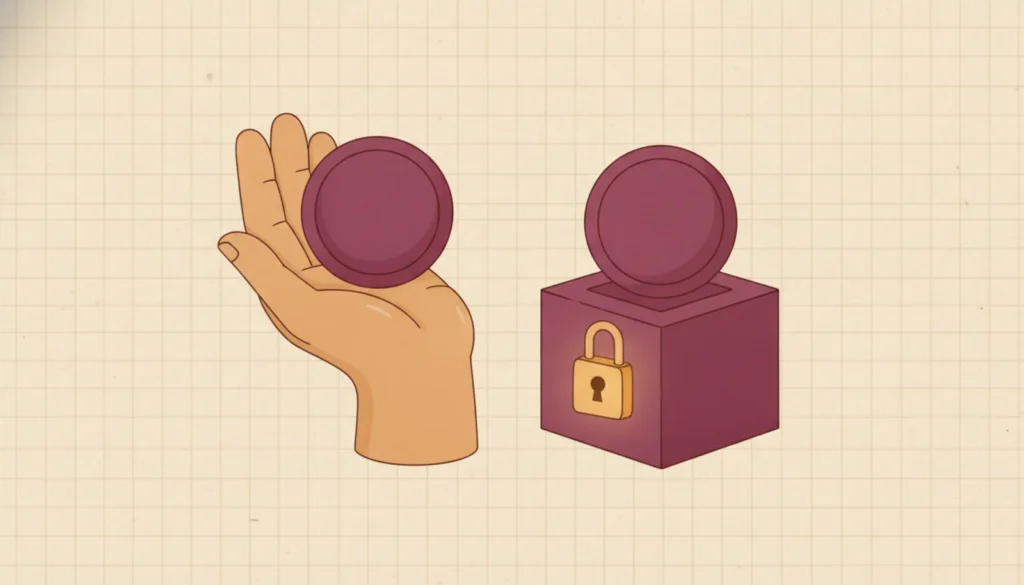
The quick version. Neither model removes risk; each one relocates it. On an exchange you trust a company’s solvency, security and access rules. In self-custody you trust your own backup discipline, permanently. Most people settle somewhere in between, and there is no answer that is correct for everybody.
The real question is what you are trusting
“Which is safer” has no answer, because the two models fail in completely different ways. A more useful question is: what am I relying on, and how would I feel if it let me down?
Our lesson on custodial versus non-custodial wallets covers the mechanics of who holds the keys. This piece assumes you already understand that and looks at the decision itself.
Worth saying plainly: this is a personal judgement about risk tolerance, technical confidence and circumstances. We are not going to tell you which to choose, and anyone who does without knowing your situation is guessing.
What you actually trust on an exchange
Three things, and they are separable. First, solvency: that the company genuinely holds what your balance says it does. Custodians have failed historically when customer assets were lent out, commingled or invested, and the balance on the screen turned out to be a claim rather than a holding.
Second, security: that the company defends its own systems, including its internet-connected wallets and its staff. Third, access policy, which is the least discussed and the most commonly encountered. Accounts get frozen for compliance reviews, withdrawals get paused, products get withdrawn from a country, and an estate can face a slow process after a death.
In exchange for those exposures you get things self-custody cannot offer: password resets, a support desk, fraud reversal in some cases, and protection from your own mistakes. Send to a wrong address from an exchange and there is sometimes a human to ask. On-chain, there is not.
What you actually trust in self-custody
Yourself, and only yourself. Nobody can freeze your wallet, close your account, or decide you are in the wrong jurisdiction. Nobody can lend out your coins either, and the balance is a holding rather than a promise.
What you take on is discipline over a long period. A backup that survives fire, damp and house moves. The habit of checking receiving addresses on a device screen. Care with the approvals you grant to applications. Sensible separation between a hot and a cold wallet.
And there is no undo. A mistyped address, a lost backup, a phrase entered on a phishing page: these are final. Self-custody moves the failure from someone else’s decision to your own error, which some people find reassuring and others find frightening. Both reactions are rational.
The two failure modes are not the same shape
Custodial failure tends to be correlated and external. It arrives without warning, affects everyone at once, and is nothing you did. Occasionally there is partial recovery through a legal process, but it takes years and is never guaranteed.
Self-custody failure tends to be individual and instant. It affects only you, it is usually total, and there is no recourse of any kind. Nobody else is even aware it happened.
That difference matters more than the raw likelihood of either. Ask yourself which kind of loss you could live with, because the honest answer often decides the split faster than any comparison of features.
Who each model tends to suit
Custody through an exchange tends to suit people holding amounts they could absorb losing, people still learning, people who buy and sell often enough that constant transfers would be awkward, and people whose living arrangements make storing a physical backup securely for years genuinely difficult.
Self-custody tends to suit people holding amounts they would be upset to lose, people who expect to hold for a long time, people who want to use on-chain applications directly, and people who do not want a third party’s policy standing between them and their funds.
Circumstances also matter more than temperament here. Someone travelling constantly, sharing a house, or without a safe place for a backup faces different constraints from someone with a stable home and a spare property to store a second copy in.
The middle path, and how to move gradually
Most people who think this through land in the same place: a small working balance on an exchange for buying and spending, and longer-term holdings in a wallet they control. It is not a compromise so much as matching the tool to the job.
Moving does not have to happen in one step. Send a small test amount first, confirm it arrives, then move the rest. Check the receiving address on your wallet’s own screen rather than trusting what the computer displays, and confirm the network matches, since the same address format can exist on chains that do not talk to each other.
Safety: Withdrawals are irreversible, so verify the address on the device screen and never paste one from a message, an email or a search result. Malware that swaps a copied address is common. Before moving anything meaningful, restore your wallet from your written backup once to prove it works. The time to discover a bad copy is before it holds your savings.
Our walkthrough on moving crypto off an exchange covers the mechanics step by step. If a single backup feels like too much concentration later on, multisig spreads the requirement across independent keys.
Key takeaways
- Neither model removes risk. An exchange asks you to trust a company; self-custody asks you to trust your own discipline.
- Access policy — freezes, reviews, closures, inheritance — is the exchange risk people meet most often, well before solvency.
- Custodial failures are external and correlated; self-custody failures are personal, instant and usually total.
- The common middle path is a small spending balance on an exchange and longer-term holdings self-custodied.
- Move gradually, test with a small amount, and prove your backup restores before it matters.
Frequently asked questions
Is a large, well-known exchange safe enough to skip self-custody?
Size reduces some risks and not others. A big platform generally has stronger security engineering and more to lose, but it is still a company subject to its own policies, its regulator and its own balance sheet. Skipping self-custody is a legitimate choice; it simply means accepting that access depends on decisions you do not control.
How much should I keep on an exchange?
That depends on facts only you know, so treat any specific figure with suspicion. A more useful framing is purpose: an amount you are actively using sits naturally where it is convenient to use, and an amount you are not touching sits wherever you have decided your keys should live. Revisit the split whenever the amounts change materially.
Does self-custody mean buying a hardware wallet?
Not necessarily. A well-made software wallet with a properly backed-up recovery phrase is genuine self-custody, and it is a reasonable step for smaller amounts. A hardware wallet mainly moves signing away from an internet-connected device, which becomes more valuable as the amount grows. If you do buy one, source it carefully; see buying a hardware wallet safely.
Can I use both without complicating my records?
Yes, and most people do. The practical trick is keeping the split simple and consistent, so you always know which wallet holds what and why. Label your accounts, keep a plain record of which addresses are yours, and store that record separately from your recovery phrase. Simplicity here is worth more than clever structure.
Educational content, not financial advice. Never share your seed phrase or private keys with anyone — including anyone claiming to be CoinCrafty.
Last updated Jul 30, 2026

Sidhartha Shukla covers crypto and business markets for CoinCrafty.