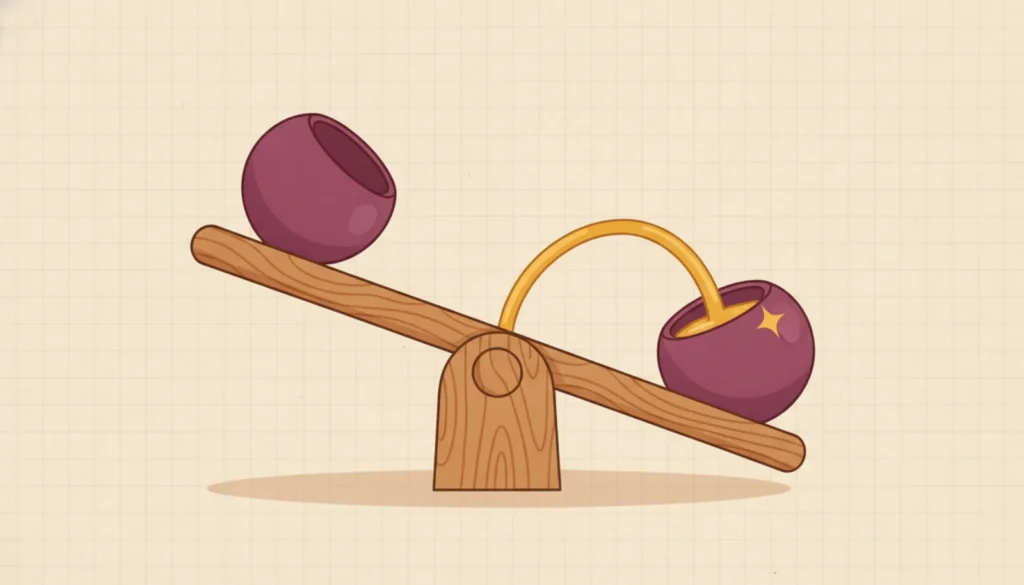
The quick version. When you provide liquidity to an automated market maker, the pool automatically sells whichever asset is rising and buys whichever is falling, so you end up holding more of the weaker one. Impermanent loss is the gap between that position and simply having held the two assets. The name undersells it, because the gap becomes permanent the moment you withdraw, and trading fees only sometimes make up the difference.
The mechanism, not the maths
Our glossary entry on impermanent loss gives the short definition. This is the longer explanation of why it happens, which is where the intuition lives.
An automated market maker does not look up prices anywhere. It quotes a price purely from the balance of what it holds, using a formula. In the classic design the two reserves are multiplied together and that product is kept constant, so as one side gets scarcer its price in the pool rises.
The formula does not know when the outside world revalues an asset. What closes that gap is arbitrage: if one of your pool’s assets rises on other venues, traders buy it out of your pool cheaply until the quoted price catches up, paying in the other asset as they go.
Now look at what happened to you. A depositor owns a share of the liquidity pool‘s reserves, not a fixed number of coins. Traders took the appreciating asset out and left the other behind, so your share was quietly rebalanced out of the winner and into the loser.
That is the whole mechanism. A pool is a standing offer to trade at the formula’s price, and the people who take it are the ones who think that price is wrong.
Why the name is misleading
The word “impermanent” describes one narrow truth. If the price ratio between the two assets returns exactly to where it stood when you deposited, the gap closes and disappears.
The trouble is that you do not control whether that happens. Withdraw while the ratio differs from your entry and the gap crystallises into an ordinary, permanent difference in what you own.
Be precise about what is being measured, too. This is a comparison against holding, not a statement that your position went down. A pool position can be worth more than when you deposited and still be well behind, and only one of those facts shows up on a portfolio screen.
Divergence loss is a better name, because the size of the effect depends on how far the two assets move apart, not on which direction they go.
An illustrative example
The numbers below are invented for the arithmetic. They are not a forecast or a claim about any real asset.
Imagine two hypothetical tokens, A and B, worth the same on the day you deposit. You put in 100 units of each, into a pool that keeps the product of its two reserves constant.
Suppose A then becomes worth four times what B is worth. Arbitrage traders buy A out of the pool until its internal price matches, and the constant-product rule determines exactly where that settles: the pool now holds 50 A and 200 B.
Count everything in units of B. Your share is 50 A, worth 200 in B terms, plus 200 B, giving 400. Had you simply held your original coins you would have 100 A worth 400, plus 100 B, giving 500. The position is up on your deposit and 20% behind holding, before fees.
Notice which asset you have more of at the end: the one that fell behind. That is the pattern, and it repeats at every scale.
When fees compensate and when they do not
Liquidity providers earn a cut of every trade, so the question is whether fee income outruns the divergence.
Choppy markets favour you. Price moving up and down repeatedly generates trade after trade, each paying a fee, while the ratio ends up near where it started.
Sustained one-way moves do not. A trend produces one long stretch of arbitrage flowing in a single direction, and that flow is precisely the mechanism rebalancing you into the weaker asset.
Two other factors are often skipped. Fee income is a share of the pool, so as more liquidity arrives the same volume is split more ways. And incentive rewards paid in a separate token are not fees, because that token carries its own risk.
Which pairings change the risk
The pairing you choose determines how much divergence is even possible, and it is by far the biggest lever you control.
- Two assets that track each other closely, such as two tokens pegged to the same unit, diverge very little, so the effect is small. The residual risk is that the relationship breaks, and a broken peg is not a small event.
- A volatile asset paired against a stable one gives you the full effect of every move, in both directions, since one side stands still by design.
- A thinly traded token paired against a major asset is the harshest case. The token can fall a very long way, and the mechanism accumulates more of it for you the entire time.
Pool design matters too, and concentrated liquidity changes the shape of the risk most of all.
Safety: Providing liquidity means giving a contract permission to move your tokens, so every other on-chain safety question applies in full. Reach the app by typing its address yourself, read what you are approving before you confirm, and revoke permissions you no longer use, as our guide to token approvals explains. Divergence loss is a modelled risk; a faulty contract can take everything.
What to weigh before providing liquidity
Start with the honest baseline: would you be comfortable holding both assets, indefinitely, without the pool? If the answer is no for either side, the pool does not fix that. It only changes the proportions you end up with.
Then look at whether the pool has real two-way trading volume rather than one directional flow, since that is what fees depend on. Add the practical frictions: network fees to enter and exit, a position that may be represented by a token you have to look after, and tax treatment, which varies by country.
Finally, keep it in proportion. Smart contract risk, oracle risk and broken pegs live alongside divergence loss, and our lesson on DeFi basics and risks covers the ones easier to miss.
Key takeaways
- An automated market maker rebalances you out of the rising asset and into the falling one, because arbitrage traders are the ones taking your standing offer.
- The measure is a gap against simply holding, so a position can be up in value and still behind; it closes only if the price ratio returns to your entry point, and becomes permanent when you withdraw.
- Fees compensate best in choppy, high-volume markets and worst during sustained one-way moves.
- Pairing is the biggest lever: closely correlated assets diverge little, while a thinly traded token against a major asset is the harshest case.
Frequently asked questions
Is impermanent loss an actual loss of tokens?
No tokens vanish. What changes is the mix you own, because the pool sells the appreciating asset and buys the depreciating one on your behalf. The gap is measured against holding both assets untouched, which is why it appears even when your position has grown in value. It becomes a realised difference when you withdraw.
Do fees always make up for it?
No, and treating fees as a guaranteed offset is the most common mistake here. Fee income depends on trading volume, on your share of the pool, and on how much liquidity competes with yours. A large one-way move can widen the gap faster than fees accumulate, and reward tokens carry their own price risk rather than being a fixed return.
Does concentrated liquidity make it better or worse?
Both, depending on what price does. Supplying within a narrow band means your capital earns a larger share of the fees while price stays inside it. Once price moves outside the band you are left holding only one of the two assets, and the divergence relative to holding is larger than in a full-range position. It demands more active management, not less.
Sources
Educational content, not financial advice. Crypto is volatile and high-risk; never share your seed phrase or private keys with anyone. Always do your own research.
Last updated Jul 25, 2026